Core
Agentless discovery
Sweeps IP ranges and domains over standard TLS, then recognises the platform behind each certificate from its handshake fingerprint. Nothing to install on any server.
Autonomous Machine Identity & Certificate Lifecycle Management
Guardian CLM autonomously discovers every TLS certificate across your external domains and internal subnets. It visualizes systemic exposure before failures occur, and is engineered for zero-touch, pre-expiry renewals across servers and network appliances (including F5 BIG-IP and FortiGate) over agentless SSH—with zero software installed on your infrastructure.
The core engine discovers, renews and deploys without agents. Intelligence layers are being added on top, and each card shows where it stands.
Sweeps IP ranges and domains over standard TLS, then recognises the platform behind each certificate from its handshake fingerprint. Nothing to install on any server.
Renews certificates and deploys them over SSH and SFTP, with a service-specific pre-check and an atomic file swap. Zero-touch scheduling is being built on this engine.
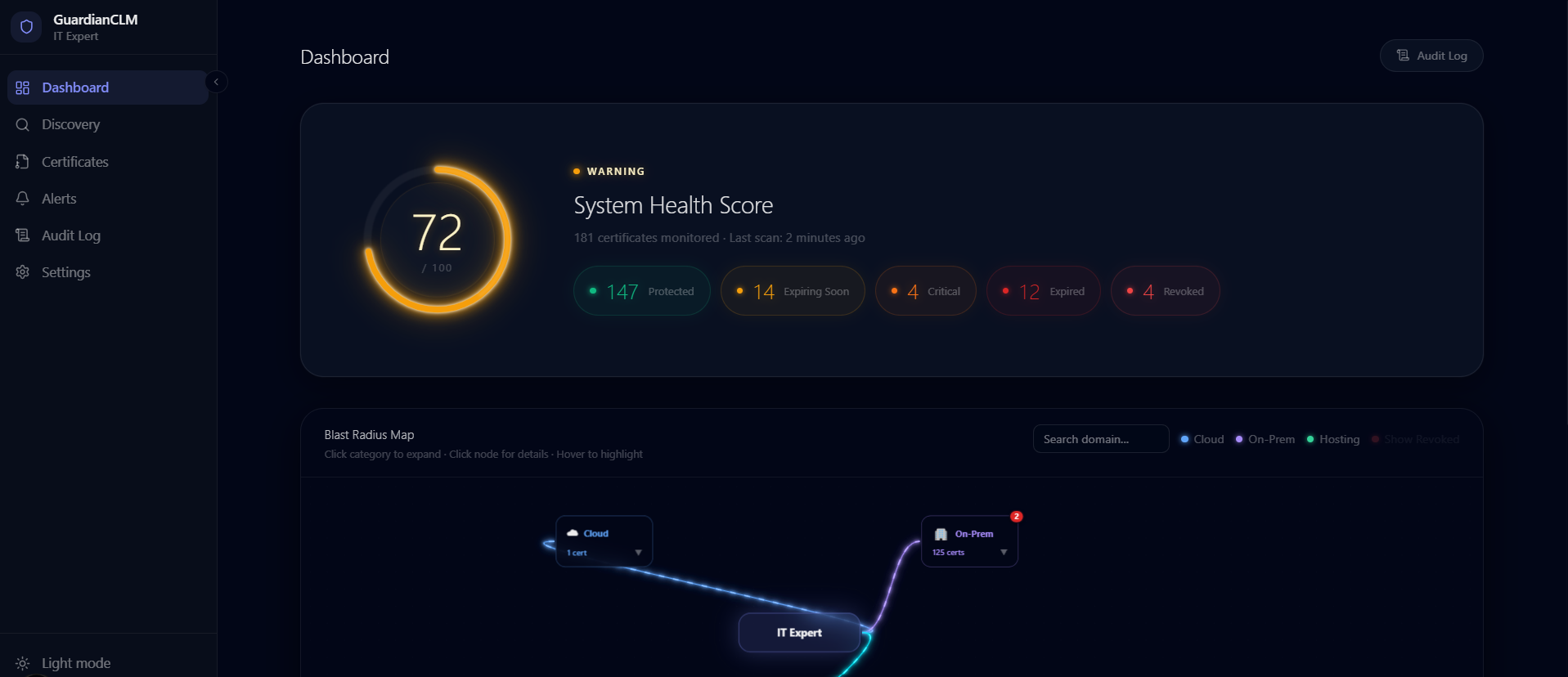
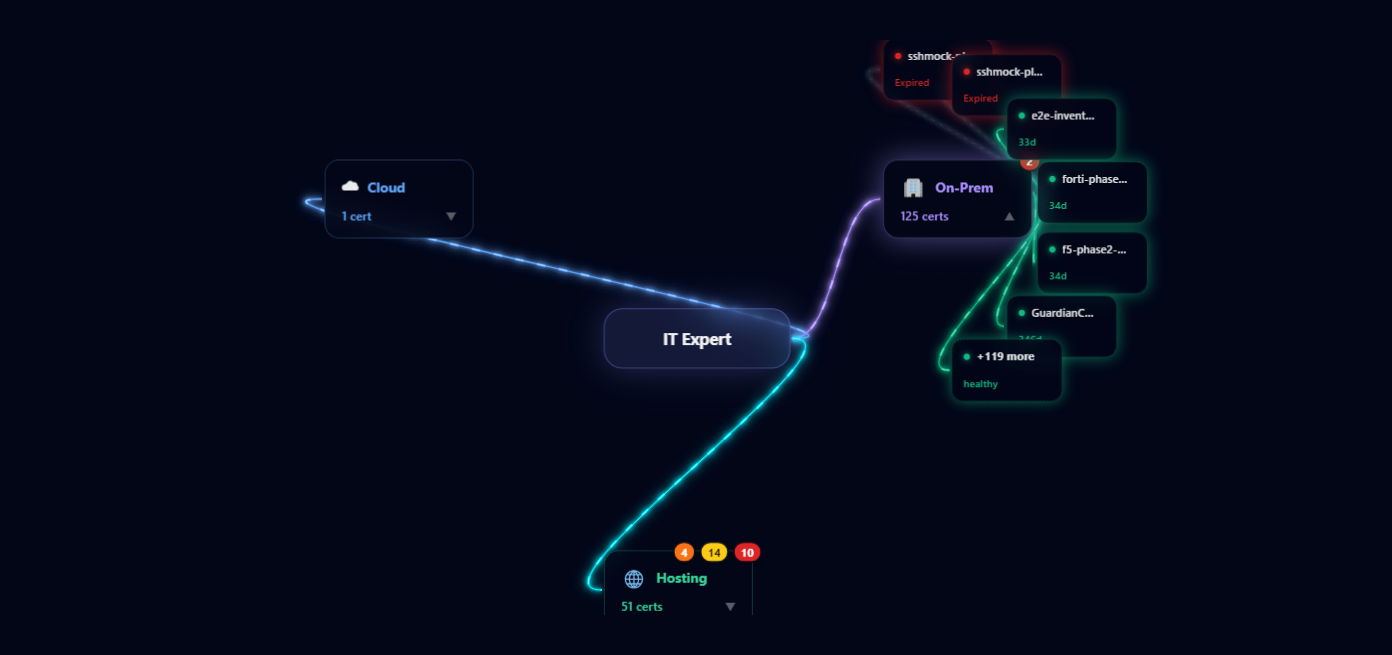
Draws your whole estate as one map, grouped by Cloud, On-Prem and Hosting, and lights up every certificate that is expired or revoked.
Flags unknown issuers, sudden certificate swaps and scan spikes. It starts with clear rules, then learns what normal looks like for your estate.
Lets your own AI assistants ask Guardian about expiring certificates through the Model Context Protocol, with every action permissioned and logged.
Shows which certificates rely on quantum-vulnerable keys and which servers already negotiate hybrid post-quantum key exchange, so migration is a plan and not a scramble.
Core features are part of the platform engine. Planned features are on the roadmap.
We designed Guardian CLM around the things that make certificate tools painful to adopt, and removed them.
Guardian reaches your servers over SSH, SFTP and standard TLS. There is nothing to install, patch or keep alive on production machines, which also keeps the security review short.
Discovery does not wait for you to register a host. It sweeps your ranges, identifies the platform behind each certificate, and lists unmanaged devices you can bring under management in one click.
The blast radius map groups your estate by Cloud, On-Prem and Hosting and highlights risk, so you see what is exposed at a glance instead of scrolling a spreadsheet.
Connectors for DigiCert CertCentral, Active Directory Certificate Services and OpenBao or Vault PKI feed one inventory. You are not tied to a single issuer.
Each deployment runs a service-specific pre-check, such as nginx -t, and swaps files atomically. A bad certificate never reaches a live service.
Architected with strict database-level tenant isolation (RLS), ready for MSSP operations.
Designed to run as SaaS or inside your own network. Secrets are kept in OpenBao, an open-source vault.
Browsers and certificate authorities agreed to cut the maximum lifetime of public TLS certificates from 398 days to 47 by March 2029. Spreadsheets and calendar reminders will not keep up.
A fleet of 1,000 certificates needs roughly 900 renewals a year today. At 47 days it needs 7,766. Every one touches a different server, owner and process, and every missed one is an outage.
Regulators in every region ask the same question: do you know what you run, and who is accountable for it?
Cyber-resilience inventory for financial and critical-infrastructure entities: which cryptographic assets you run, who owns them, and proof that they are controlled.
NIST SP 800-207
Continuous machine identity verification. Guardian keeps a live record of which certificate identifies which system, so trust is checked and not assumed.
Visibility and control that align with GCC and international critical-infrastructure regulation, wherever your estate runs.
Guardian CLM supplies a live inventory of every certificate, its owner, its expiry and an audit log of every change. It supports your compliance work and does not replace it.
Guardian CLM reaches your network from the outside, finds every certificate, and maps what each one protects. Select a pulsing marker to inspect an exposed certificate.
Sweeps IP ranges and domains over standard TLS and recognises the platform behind each certificate. Nothing is installed on your servers.
Groups every certificate into Cloud, On-Prem and Hosting, and lights up what is expired, revoked or about to be.
Pushes replacements over SSH and SFTP, runs a service-specific pre-check, and swaps files atomically.
Real screens from the Guardian CLM console, not mock-ups.
Sweeps public domains and internal RFC1918 subnets over standard TLS handshakes. Identifies rogue and self-signed certificates, platform fingerprints, and key health without deploying a single sensor.
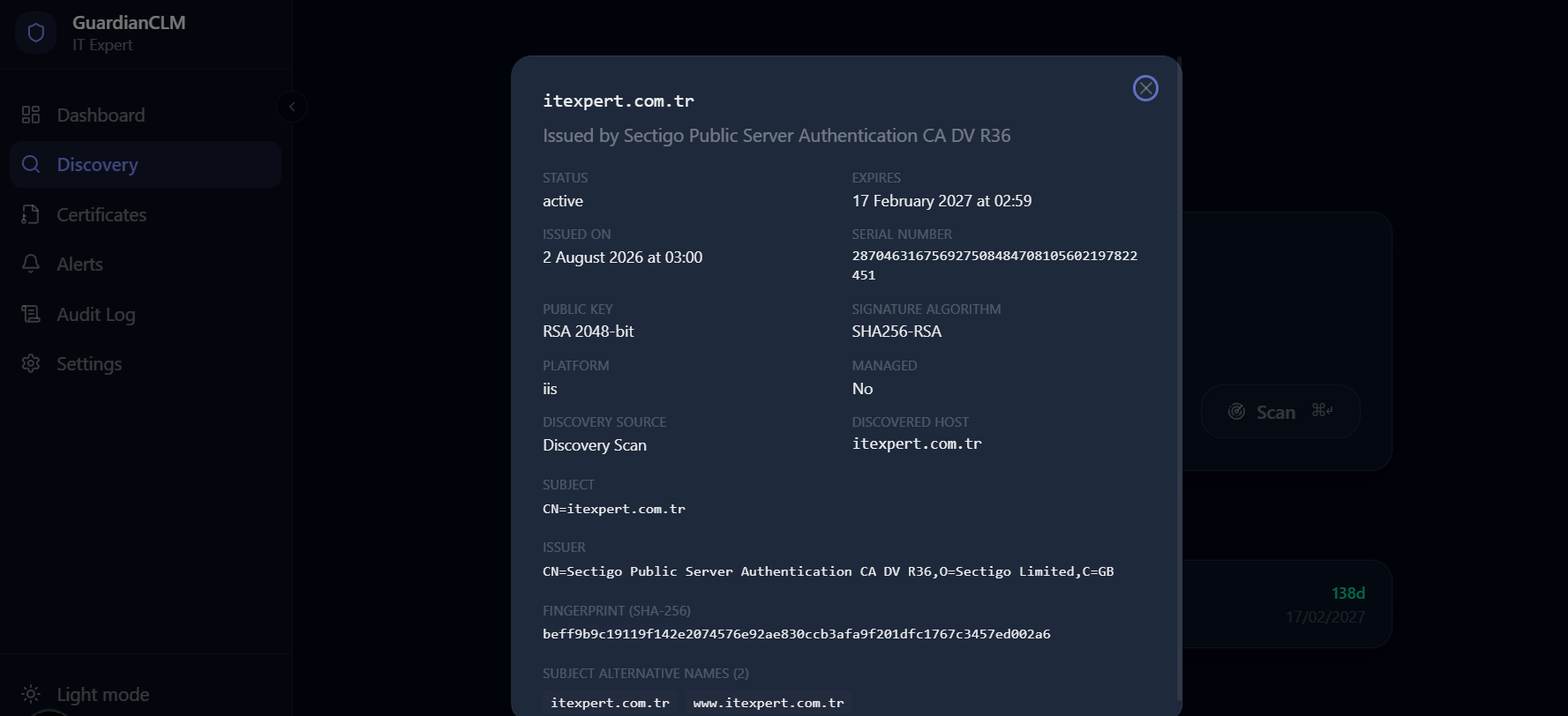
Tap the screen to view it full size.
Three phases, from a dependable agentless core to a certificate estate that runs itself.
Active
The foundation: see every certificate and deploy without agents.
Next
From reacting to expiry to predicting risk.
Later
Certificates that manage themselves, ready for quantum.
Phases are ordered by priority. Scope and timing may change.
Join the closed pilot and run Guardian CLM on your own network.